
Interview with strategic analyst C Raja Mohan on the recent Nuclear Summit in the US

India looks forward to the meet between Prime Minister Dr Manmohan Singh and Chinese premier Xi Jinping's in Durban on March 27 on the sidelines of the BRICS summit. The next week is important for Sino- India bilateral relations, says Sheela Bhatt.

The leaders of the two countries "discussed the main aspects of bilateral cooperation and exchanged views on current regional topics, including developments in South Asia," said a brief statement issued by the Russian President's office - Kremlin.
Our strategic and national security interests should be the decisive factor in our policy-making towards Israel, the US and Iran, says B Raman.
'Nuclear safety evaluations are being put in the public domain to enhance transparency and boost public confidence,' the prime minister told the second Nuclear Security Summit. Nikhil Lakshman reports from Seoul

India and China on Wednesday signed in all nine agreements, including the Border Defence Cooperation Agreement and one on strengthening cooperation on trans-border rivers, after restricted and delegation-level talks that lasted over two hours as Prime Minister Manmohan Singh and Premier Li Keqiang met for the second time this year for talks which the Indian leader described as "fruitful and productive".

Prime Minister Dr Manmohan Singh on Sunday underwent a routine medical check-up.Informed sources confirmed that such a medical check-up is a must before undertaking a foreign trip. Dr Singh is scheduled to visit Pittsburgh in the United States next week to attend the G-20 Summit hosted by US President Barack Obama. Media Advisor Harish Khare said Dr Singh's health was fine and he was attending to his work as usual.
Prime Minister Dr Manmohan Singh addressed the media persons onboard Air India One on his return from G-20 Summit in Toronto.

The Korean summit, laden with symbolism in everything from the choice of location to the mango mousse for dessert, could just be the first round in a continuing dialogue, says Dr Rajaram Panda.
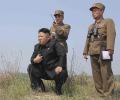
'Hardliners who are against denuclearisation may be working secretly on North Korea's nuclear activities, despite official claims that dismantling its nuclear arsenal has already begun.'' 'Does it mean that Kim does not have full control over the military,' asks Dr Rajaram Panda.
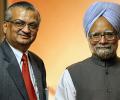
'Dr Singh, visibly relieved, said, 'Yesterday night I couldn't sleep. I stayed awake, praying throughout. You have saved the country'.' A fascinating excerpt from former atomic energy chief Dr Anil Kakodkar's memoir Fire And Fury: Transforming India's Strategic Identity.

Two-time Olympic gold medal-winning hockey legend Keshav Datt died on Wednesday due to age-related ailments, marking the end of a glorious era in the sport.
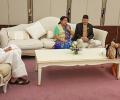
'Instead of writing NAM's obituary, India should reinvent it,' suggests Dr Rup Narayan Das.

'The coming two months could unfold unpredictable results or unpredictable consequences or both at the same time,' says Rajaram Panda.
A day after attending the India-Asean summit and the East Asia Summit in furtherance on India's Look East policy, Prime Minister Manmohan Singh on Sunday credited Singapore for leading to the strategic shift in the nation's foreign and economic policies.
While the delegation accompanying Prime Minister Dr Manmohan Singh on his 9th India-Asean summit said that the India-China relationship was a 'complex' one, they also emphasised that India-US relations were in good shape, reports Saisuresh Sivaswamy, who is a part of his media delegation accompanying the prime minister to Bali.
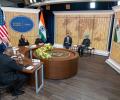
The virtual meeting comes in the midst of some disquiet in Washington over India's position on the Ukraine crisis as well as its decision to procure discounted Russian oil.
Apart from emphasising the importance of India's economic development, and its re-integration into the global economy, Dr Singh has repeatedly emphasised the importance of the ideas that define the Indian civilization and the Indian Republic for global peace, security and challenges, ranging from terrorism to pandemics.

India wants more business and closer engagement with ASEAN even as China's influence spreads in the region. Rediff.com's Sheela Bhatt, who is travelling with the prime minister on his visit to Brunei, reports from Bandar Seri Begawan, capital of the tiny oil-rich country.
The Arab world believes that many of those leaders present in Baghdad for the Arab League summit last week do not represent them and that the wave of changes will hit their shores sooner than expected. We may thus have to wait for more summits to see true Arab leaders emerging, writes Dr Waiel Awwad

On his second day of the visit, Modi visited the International Rice Research Institute in Los Banos, an urban locality situated at a distance of around 65 km from Manila -- the capital of the Philippines -- and then visited the Mahaveer Philippine Foundation, that provides free Indian-made prosthesis 'Jaipur Foot' to needy amputees. Here are images from Modi's second day in the Philippines.
'The BJP's all-India plans can be expected to become clearer around 2022-2023, particularly if -- as some anticipate -- the senior Congress leadership cracks, broadly as between the Nehru-Gandhi loyalists and those who may be termed 'pro-changers',' observes Arun Bhatnagar, a retired IAS officer.
'By not even acknowledging China's occupation of Indian territory Modi signalled to Beijing that he was not prepared to used forceful means to vacate the Chinese occupation, and that his government was reconciled to this loss of territory and accepted the fait accompli engineered by the PLA.'
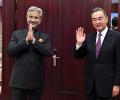
China is ready to take "conciliatory steps" in order to avoid new violations of the obligations on the India-Chinese border, Chinese Foreign Minister Wang Yi said on Friday, a day after holding a crucial meeting with External Affairs Minister S Jaishankar over the current standoff in Ladakh. Speaking during a joint press conference with Russian Foreign Minister Sergey Lavrov, Wang said troops and equipment should be withdrawn from the Line of Actual Control (LAC).
'India's relationship with China has been and will continue to be complex, delicate and sensitive,' says Rup Narayan Das.
'Countries in possession of nuclear weapons have a heightened sense of power and it is logical for Kim to expect/demand to be treated as an equal at any bargaining table.' 'It is here that Trump ought to respect Kim as the leader of a sovereign power and not treat the North Korean leader as a subordinate,' says Dr Rajaram Panda.

Both nations have to find ways to be sensitive to each other's politico-strategic and economic concerns, say Dr Rahul Mishra and Sana Hashmi.

British Prime Minister Theresa May will be in India tomorrow, but Cyrus Mistry will no longer head the Indo-UK CEO forum.

In democratic India, a citizen can be a patriot and at the same time be critical of the government, unlike China which promulgated a national security law in Hong Kong prescribing patriotism to contest elections, observes Rup Narayan Das.
'It seems a wiser decision to pull out at the right moment than regret after joining the pact,' explains Dr Rahul Mishra.
In his customary pre-departure statement, Dr Singh said it was in India's interest to have an open, stable and rule-based international economic environment.
Pakistan Prime Minister Yousuf Raza Gilani is unlikely to meet his Indian counterpart Dr. Manmohan Singh in Washington, where they are scheduled to attend the Nuclear Security Summit in Washington on April 12 and 13.
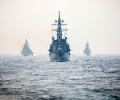
'Any future course of action towards active participation in the alliance when formed would need a lot of deliberation, long term vision and should be in our best national interests,' notes Commodore Vengalil Venugopal (retd).

Senior American administration and diplomatic sources who sat in on the 50-minute mini-bilateral summit between President Barack Obama and Indian Prime Minister Dr Manmohan Singh, spoke animatedly how the "atmospherics were excellent," and what "a delight it was to watch the substantive interactions between these two extremely cerebral individuals".

It was clear in Brunei at the 8th East Asia Summit that China doesn't want the South China Sea issue to even dominate the discussion, reports Sheela Bhatt, who is part of the prime minister's media contingent to the summit
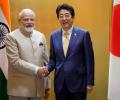
With the signing of the pact, the Quad grouping of India, Japan, Australia and the US is set to gain more heft now, notes Dr Rajaram Panda.

'We have been bold and innovative on recognition in the past and we do not need to rush,' advises Ambassador T P Sreenivasan.

'This novel format of diplomacy -- the informal summit -- will not only facilitate bilateral communication and reduce miscalculations at the very top level of the two governments, but possibly open the space for China and India to speak in one voice on various issues of mutual concern,' note Feng Renjie and Ding Kun Lei
Rediff.com's Vipin Vijayan, who is travelling with Prime Minister Manmohan Singh to Japan, reports from the significant bilateral meeting with Japanese Premier Shizo Abe in Tokyo.
